Monday, April 1, 2013

Terrorist State Label: How Pakistan Can Use Digital Marketing to Improve its Image?

The day Pakistan decided to become an ally of America’s War on Terror, it became a prime target of terrorism itself. Since 2001, Pakistan was targeted by hundreds of terrorist attacks causing more than 40,000 civilian and security personals losing their lives.
Instead of recognizing Pakistan’s sacrifices in this war, now it’s known as Terrorist State in the world. We can’t be relaxed telling ourselves that this is not true and that it is just a propaganda against Pakistan. Lie or truth doesn’t matter in this world anymore; people buy what big Media houses sell — and this is what exactly is happening here.
Pakistan is an exporter of terrorism: this is a truth of today, largely known in the western world.
Clearly this is a major failure of our foreign policy but what is gone is gone, now we have to rethink and redesign our policies to improve the image of Pakistan in the outer world.
A short-term result driven policy should be to change the general perception about Pakistan in west. A foreign relations analyst can explain this in a much better way but in my opinion, as a marketer, the primary goal should be to reach out each and every individual living in these influential countries and show them the real face of Pakistan.
The peace loving people, foreign tourists’ accounts, talented students, and energetic youth. I will bring them all to YouTube to watch positive documentaries about Pakistan, directing them to web pages to learn sacrifices, losses and contribution in this so called War on Terror.

How Do We Do It?

How would you do it on state level? You’ll probably task your embassies to build a very effective PR campaign, reach Newspapers and Magazines like New York Times, Wall Street Journal, and Times etc. You may want to run Ads on CNN, BBC and other major global TV channels.
This is a fine approach but what if Newspapers and TV channels refuse to run your message?
I believe traditional media won’t work in this case as they have their own interests and won’t be able to deliver our message to desired extent and even if they agree to run our PR campaigns, a country like Pakistan won’t be able to sustain because of huge budget required for such campaigns.

Here Comes Digital Marketing:

When you type “Pakistan is” in Google search, its instant feature shows relevant suggestions based on the searches of other people from around the globe.
clip image002 Terrorist State Label: How Pakistan Can Use Digital Marketing to Improve its Image?
When you type “Terrorist Groups”, there is a Pakistan in suggestion as well.
clip image004 Terrorist State Label: How Pakistan Can Use Digital Marketing to Improve its Image?
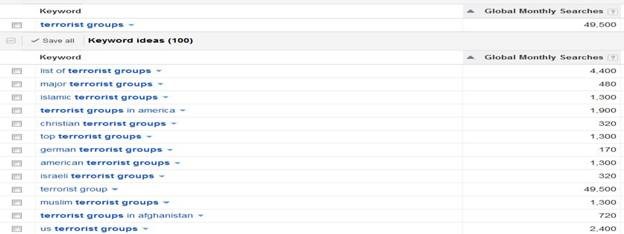
Google Keyword Tool tells us that there are approximately 50,000 people searching for a keyword “Terrorist Groups”.
clip image014 thumb Terrorist State Label: How Pakistan Can Use Digital Marketing to Improve its Image?
Consequently, these search results — with plenty of negative stuff on Pakistan — are clicked and read by millions of internet users across the globe. And interestingly, we are letting this happen without a counter policy to defend our name.

Search Engine Optimization

Have a look at following search results:
clip image006 Terrorist State Label: How Pakistan Can Use Digital Marketing to Improve its Image?
First thing that we can do is to bring some sites — with our own driven content and positive things about Pakistan — up on top in Google search results pages.
This is very much do-able and technique used to bring your own site up in search engines is called Search Engine Optimization (SEO). With the help of SEO, we can bring our own websites with positive image about Pakistan whenever anyone in this world searches for such keywords.

Contextual ADs

If you are regular internet user then you might have noticed third-party ads running on the websites you frequently visit and you may have noticed that  ads are relevant to the subject of the visiting website.
These are contextual ads — a way of displaying advertisements based on the content displayed to the user.
Using such contextual techniques we can target those websites where negative news about Pakistan appears. To do this, we’ll take help from Google once again — a major player in contextual advertising.
We can design ADs, specifically tailored for such website with negative content about Pakistan. If executed well, we can show our ad to those people who are reading anything related to Pakistan.
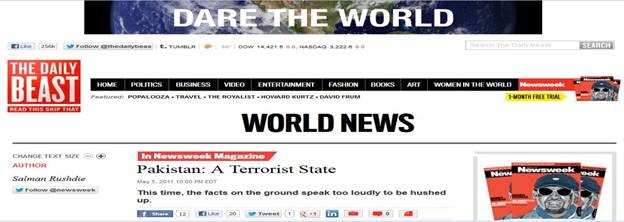
For example; image shown below shows an article written by Salman Rushdie.
clip image010 thumb Terrorist State Label: How Pakistan Can Use Digital Marketing to Improve its Image?
We may not stop him to write anti-Pakistan articles and can’t force this website to stop publishing such articles but what we can do is simply run a positive ad on this website with strong message and intriguing the reader that Pakistan is not terrorist state and you should learn more about it by clicking this ad.
That ad should lead the visitor to well documented website where fact and figures with proves tell him the whole new story about Pakistan. The Ad spot you can see above the article with a text “Dare the World”.
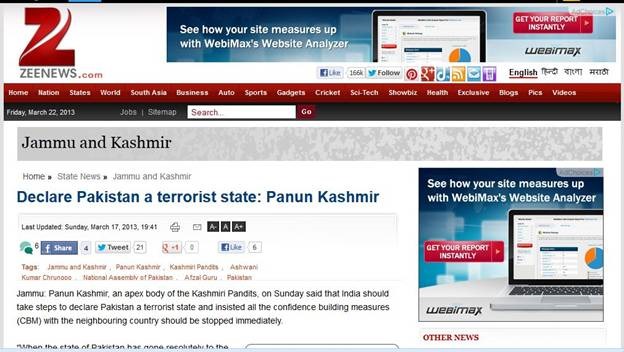
Similarly, on the website below…
clip image012 thumb Terrorist State Label: How Pakistan Can Use Digital Marketing to Improve its Image?
We can create communities on Social Media sites like Facebook and engage western citizen in healthy discussion about Pakistan’s role in War on Terror. Facebook ads can help us reach every single individual living in USA and other countries.
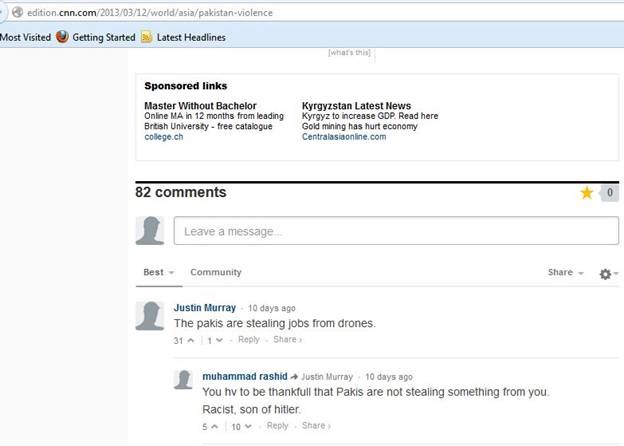
CNN reported a recent blast in Pakistan at the link below…
I am not showing here the original news story but what happens after such news reporting is important to learn for Pakistanis.
clip image016 thumb Terrorist State Label: How Pakistan Can Use Digital Marketing to Improve its Image?
Just below the story you can see “Sponsored Links”. We can target them to show our message.
On a related note, just read the first comment posted by “Justin Murray”. Instead of being sorry for such sad news, he is making fun of Pakistanis and interestingly got 31 “Votes-Up” for his comment while a Pakistani who spoke in favor of Pakistan got 10 “Votes-Down” for his comment.
This tells us whole story about what is happening online and what people think about Pakistan. A lot of negative stuff floating on internet about Pakistan, call it conspiracy theories, propaganda or whatever you want to say but I have just one question; whatever it is, don’t we need a counter strategy?
This strategy requires state-level support or someone who loves Pakistan more than his money to support a team of Digital Marketers to successfully implement and run it. We can’t stop them to write negative but we can decrease its impact to significant level.
Imagine, all internet surfing US citizens viewing ads about Pakistan on regular basis all the time they search Google, visit particular websites, use Facebook, Go to YouTube etc. After some time these ads will start hitting their minds and they’ll definitely try to learn more.
Political Leadership, Army and ISI should think about it. You are spending billions to stop the enemy entering our border lines but did you know they have already crossed our eBoarder? Are you prepared for eWar? And do you have eSoliders? I wanted to write how our enemies penetrated into us using eStartegies and Social Media but I have already taken your lot of time so leaving it for now.

Friday, March 29, 2013

Microsoft Pakistan Inspires Young Girls Towards IT Professions

Logo digigirlz withtext 2 Microsoft Pakistan Inspires Young Girls Towards IT ProfessionsMicrosoft Pakistan recently conducted DigiGirlz Camp 2013 to foster Information Technology related education among young women of Pakistan.
DigiGirlz is a Microsoft Youth Spark Program which is a signature platform to invest in Science, Technology, Engineering and Math (STEM) education for young women and build a pipeline of future workers ready for the challenges of the global economy.
The Microsoft DigiGirlz High Tech Camp was developed to provide girls with a better understanding of what a career in technology is all about. This exciting experience provides high school girls with opportunities to learn about careers in technology, talk with Microsoft employees about their life experiences, and enjoy hands-on computer and technology workshops.
The camp includes experiential work with robotics, demonstrations of the use of simulation technology, experiences with technology like Windows 8 touchscreen slates, sessions on branding to teach the girls the importance of branding themselves the way they want to be known, speed networking sessions with Microsoft employees, Geoteaming Scavenger Hunt and many other unique experiences highlighting teamwork.
Speaking on this occasion, Amir Rao, country manager, Microsoft Pakistan said, “Today Information Technology is an inherent part of our society; it impacts all elements of society and infuses every aspect of the society and thus forms the basis of modern innovation .For that, DigiGirlz as part of our Youth Spark program helps provide young women with the skills they need to be able to fill the jobs of today and tomorrow and to be able to understand the impact they can have on the future society they belong to. This program aims to encourage and support young women to pursue education in high demand areas such as computer science, build their skill set and to incite them to find jobs in the IT sector in which they can have an essential role and contribute heavily in its growth.”
This was first ever Microsoft’s DigiGirlz camp in Pakistan.

The New ThinkCentre Edge 62z is a Budget AIO PC from Lenovo

ThinkCentre Edge 62z The New ThinkCentre Edge 62z is a Budget AIO PC from Lenovo
Budget All-in-one PCs. How often do you spot machines with both of those traits on the market? The answer’s obvious: not often. But Lenovo is here to break the ice once this time, offering the ThinkCentre Edge 62z.
The new AIO PC will be available at a (relatively) low cost of $549 or around Rs. 60,000. Instead of hardcore gamers, this system is targeted mainly towards offices and moderate users.

The specs

The machine will come with an 18.5 inch LCD display. That is said to be 65 percent less space-consuming than a 20 inch monitor.
Inside the machine beats an Intel Core i3 processor, but you can go all the way up to a crème de la crème Core i7 one. The amount of RAM you can get tops out at 8GB, and for the hard drive, 1TB is the limit.
The number of USB 2.0 ports (C’mon its a budget system after all) set is 6. A DVD burner is added in the mix too. Above the display, there’s a webcam. The ThinkCentre Edge 62z also comes with Integrated Intel HD Graphics.
An interesting thing to note here is that this thing comes with Windows 7. Its not the latest version but will be fine enough for a PC with no touchscreen. And a bit old hardware. The PC will be released in May for $549 or around Rs. 60,000 this year.

BlackBerry Reports Profits and Loads of Optimism

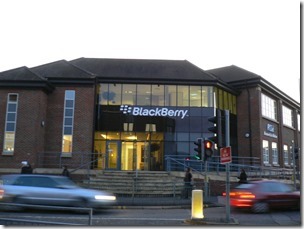
BlackBerry Office BlackBerry Reports Profits and Loads of OptimismBlackBerry has finally announced its quarterly earnings after its name change. The new report comes with good news and hope of the arrival of better times.
To start off, BlackBerry said it earned profits of $94 million on $2.7 billion revenue, which may sound tiny compared to the 10 or even 11-digit figures of the industry leaders but is none-the-less a good start.
The no. of devices sold topped out at 6 million but out of those only around 1 million were BB10 products, namely the Z10. It is worth noting however that the Z10 has only just been launched on some crucial markets. Over 370,000 units of the PlayBook tablet were sold too.
Not everything is as rosy though. The company has said that its total no. of subscribers actually dropped, from 79 million to 76 million. A good bit of news however was that 55 percent of people coming to BlackBerry were coming from other platforms, while only the remaining ones were first time smartphone owners.
That surely is a good news as it indicates that the company has finally started to incur some pressure on the competition.
As it is turning out, the fight between Windows Phone and BlackBerry 10 will be the one to watch out. Both the companies, BlackBerry and Nokia (because WP is essentially about Nokia) have shown good, encouraging progress towards better times and will be ones fighting to get the third spot behind iOS and Android, or the spots above it in the long run, who knows.

Thursday, March 28, 2013

Allied Bank to Get TPS IRIS Multi-Channel Enterprise Switch

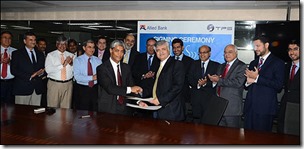
print media thumb Allied Bank to Get TPS IRIS Multi Channel Enterprise SwitchTPS, a cards and payment solutions provider, has announced that Allied Bank Limited has decided to upgrade to TPS’ next generation multi-channel payment solution ‘IRIS’ to support its ambitious growth strategy.
Following a detailed switch selection process, where solutions for both in-house and outsourcing models were evaluated, Allied Bank has selected IRIS as its in-house payment switch because of IRIS parameterization, scalability, reliability and supporting cost-effective growth.
IRIS is a sophisticated payment application that offers one window solution for transaction processing, debit and prepaid card management, ATM controller, Transaction and ATM network Monitoring, Integrated Channel Management and ADC CRM.
Supported by IRIS advanced features, Allied bank can accelerate the execution of its far reaching strategy, including upgrading the network to support chip-cards, advance its mobile banking initiative, while providing value-added services to its accountholders. The bank will also benefit from a lower Total Cost of Ownership (TCO), increased speed to market and facilitate in channel growth. Additionally ABL will use Instant Card Issuance capabilities, comprehensive Point of Sale (POS) and other payment products.
TPS has been associated with ABL since 2003 when it was selected by the bank to setup a transaction switch ‘Phoenix’ and other peripheral applications. In the span of 9 years, TPS technology has facilitated bank to scale and handle ATM network of 700+ ATMs and process the card life cycle of over a million debit cards.
To smoothly execute this upgrade project, TPS and Allied Bank has assigned a dedicated team consisting of highly motivated and trained senior personnel to manage this challenging and strategic project. All assigned resources will work as a closely-knit team with the aim to successfully deliver this project timely.
“At Allied bank we aim to offer innovative solutions and value added services to our customers. To meet this objective we plan to fully utilize IRIS scalable and modular architecture and features by rolling out new products and services, meeting customer’s requirements and expectations within shortest possible time. Our strategic partnership with TPS will contribute in our technology transformation and enhancing our service capability and to offer convenience and exclusive services to our customers,” said Mujahid Ali, Group Chief, Information Technology, Allied Bank Limited.
“It gives us immense pride to be a trusted partner of ABL, and be a part of ABL’s continuous retail payment growth initiative. We greatly value ABL’s confidence and trust in us and we are certain that the partnership of TPS and ABL will deliver long term benefits.” said Muhammad Sohail, CEO, TPS