Wednesday, May 19, 2010

PTCL Offers Quad-Play: Unlimited Voice, Data, IPTV and Surveillance


PTCL is offering bundle package for its home users against a fixed monthly rental. Bundle offer includes following four services:
  • Unlimited on-net calls
  • Unlimited broadband
  • SmartTV (IPTV) with all available features
  • IP based home surveillance camera to secure your home from any sort of intrusions or threats
PTCL Quad Play’s Smart TV service comes with all its features, for instance
  • Rewind and pause live channels, which means that you can watch multiple programs being broadcast on different channels at the same time according to your desires by rewinding and watching the missed portion of the program while you were watching the other program
  • Video on demand (VOD) that includes over 500 movies of your choice and
TCL Quad Play’s home surveillance camera comes with multiple features such as;
  • SMS, e-mail and Voice alerts incase of any intrusion in your home
  • Remote live viewing of your home on your computer or mobile phone
  • Recording and storage of your camera surveillance which you can retrieve at any time
To know more about home surveillance system click this link
PTCL Quad Play service will be installed at the customer premises within 7 to 10 days from the date of order placement.
Tariff:
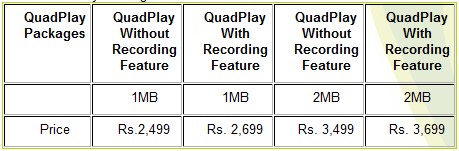
PTCL quad play Tariff PTCL Offers Quad Play: Unlimited Voice, Data, IPTV and Surveillance
Equipment Charges:
You can pay one time for Equipment (Smart TV STB & Camera) Rs. 22,000 or otherwise monthly installment of Rs. 1050 for 24 Months
Availability:
  • Lahore
  • Karachi
  • Islamabad

OmniVision Makes World's Smallest 1080p Camera

Get ready to view cam addicts in a whole new form of clarity.
Ready for your close up? OmniVision this week introduced the OV2720, which it claims is the world's first 1/6-inch, native 1080p/30 high-definition CMOS image sensor designed for notebook, netbook, webcam and video conferencing applications. Based on OmniVision’s 1.4 micron OmniBSI backside illumination technology, the new 1080p sensor delivers video conference quality HD video recording in a small enough form factor (z-height of 3.5 mm) to meet the module size and height requirements of today's thin notebook designs.

Next PSP 'F**king Powerful,' Packs 4-Core Cell CPU

The next PSP won't be arriving until 2011 but here are a few tidbits of information about the device to whet your appetite.
Last week there was talk of Sony introducing another PSP at E3 this year. The evidence, based on nothing more than whisperings from game publishers with increased Q4 marketing budgets, wasn't exactly strong, many saw the PSP2 as a way for Sony to redeem itself and make up for the PSPGo. Today, we have more evidence that the PSP2 exists and according to these reports, the device is a powerful machine.

Tuesday, May 18, 2010

Next-gen AMD Fusion CPU + GPU Coming in 2015

AMD planning big things for its Fusion of the future.

AMD's initial product based on its Fusion initiative, codenamed Llano, is now sampling with vendors. This first iteration will combine the GPU and CPU on the same die, which will drive down power requirements and costs.
While Llano will be based off of Phenom II technology and will be paired with ATI Radeon GPU design, AMD says that its next-generation Fusion will blur the line between CPU and GPU. That next big change is planned for 2015, Leslie Sobon, vice president of marketing at AMD, told IDG.
The next Fusion will have the philosophy of full integration of both GPU and CPU, aiming to take full advantage of new standards like OpenCL.

Seagate: Industry Not 3TB HDD Capacity-Ready

While confirming that a 3 TB HDD will be announced later this year, Seagate has explained the hurdles the company is facing to make it happen.
While confirming that the company will indeed announce a 3 TB hard drive later this year, Seagate product manager Barbara Craig admitted that moving to a capacity greater than 2.1 TB requires more work than merely upping the areal density. In fact, most PCsjust aren't built to cope with hard drive capacities beyond that limit thanks to the original logical block addressing (LBA) standard set by Microsoft and IBM twenty years ago.